Partner Kaitlyn Glancy provides actionable tips on hiring strong sales leaders, drawing from her experience at Flexport, where she helped scale revenue from $1M to $2B, and advising several of Eclipse’s portfolio companies.

Founders often believe that a great product alone will lead to a startup’s success, but that’s rarely the case. On your journey to building a product that customers want, you’ll need constant interactions with your customers, and you’ll eventually need to hire sales leaders that can communicate your vision and sell on your behalf. In these early days of startup growth, choosing your first sales leader is a critical decision, which can quite literally make or break your company. This person will drive revenue, navigate complex enterprises, and gather direct customer feedback that will impact your product lifecycle and, ultimately, scale your company. But startup sales leaders have some of the highest turnover rates across industries. It’s even more important to be careful with headcount resources under uncertain economic climates with heightened competition. The root cause of most misfires usually boils down to one thing: mismatched expectations between the founder and the sales leaders. Making your first sales hire doesn’t need to be rocket science (save that for your product!). Here’s what hiring great sales leaders looks like in practice. We’ve broken it down into three phases: before, during, and after the hiring process.
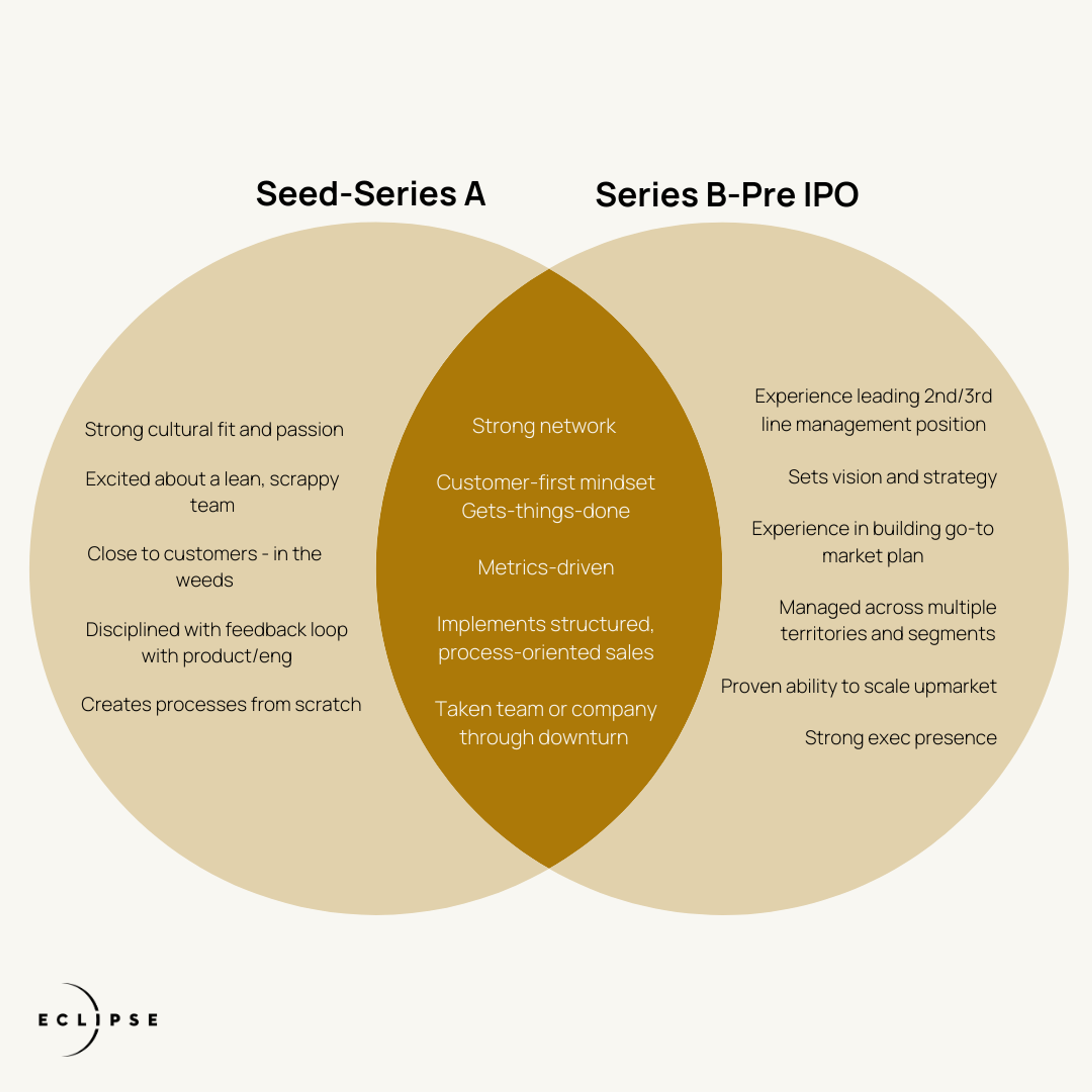
Before You Hire…1. Make sure you’ve closed 5-10 deals yourself As the CEO, you need to have personally closed or been directly involved in closing your first handful of sales (ideally closer to 10 or 20!). Bottom line: if you’re thinking, “We have a great product, and we just need someone to sell it,” — it’s not the right time to hire a sales leader. Don’t start hiring until you have a strong understanding of customer persona, including: – What is the problem you’re solving?
– How does your solution address that problem?
– Who is experiencing the problem?
– Who is the buyer?
– How much of the budget are they willing to spend to solve that problem?
– What happened when the customer used your solution? What was their feedback? What worked well and what didn’t work well? 2. You’re accountable for setting their initial sales goals Many sales leaders fail because the definition of success wasn’t clear from the outset. As the CEO, you are accountable to set the goals based on what you learn from bullet #1. Define sales growth goals that are tangible over the first couple of years (12, 24, 36 months) to help establish a north star for your sales leader from day one. It’s fine to adjust post-hire as needed, but you should set the initial goals. Here are some examples: – Achieve $XM in bookings and/or $XM in recognized revenue by EOY 20XX– Acquire X new logos by EOY 20XX– Retain current client base, to achieve goal of X active accounts by EOY 20XX– Hire X new AEs that consistently attain 80% or more of quota It can be tempting to be swayed by impressive company names on a resume, like Fortune 500 or late-stage startups. While such hires can possess strong skills in scaling sales teams, make sure their experience and goals align with your needs. For example, Early-Stage startups need leaders to close deals themselves and be in the weeds with you. One important point to note: ensure that your first sales leader is comfortable and enthusiastic about managing individual contributors. One common mistake we see when over-hiring is that the senior leader may not have recently managed frontline sellers and may immediately seek to add additional layers. Companies often make the mistake of hiring someone too focused on details that’s better suited for seed or Series A startups, when they need a more strategic leader for a Series B, or vice versa. Focus on key skill sets based on the stage of your startup.